
Jesus Knocking on Heaven’s Gate: The Promise of Revelation 21 and 22

Heaven is often pictured as a faraway place with closed doors, as if the faithful wait outside and wonder whether they will be welcomed in. Revelation 21 and 22 give a different picture. The final vision of Scripture shows a holy city coming down, gates standing open, tears wiped away, death defeated, and Jesus speaking the last invitation.
The phrase “Jesus knocking on heaven’s gate” is poetic, not a direct quote from Revelation 21 or 22. Yet it captures something true about the final chapters of the Bible. Jesus is not locked out of heaven, and heaven is not locked against those who belong to Him. He stands at the edge of history, announcing that God’s dwelling will be with His people. He does not merely point toward paradise. He brings it near.
Revelation ends with a promise, not a puzzle. Its final vision is full of symbols, but those symbols carry clear hope. God will make all things new. Evil will not have the last word. The Lamb who was slain will reign. The thirsty will drink freely from the water of life. The gates will not close.

Revelation 21 begins with a new heaven and a new earth
Revelation 21 opens after judgment has passed. John sees “a new heaven and a new earth.” The sea, often a symbol of chaos and danger in Scripture, is no more. Then John sees the holy city, the new Jerusalem, coming down from God.
That direction matters. The final hope is not only that souls go up. The vision shows God’s renewed world coming down. Heaven and earth meet. Creation is healed. God does not abandon what He made. He renews it.
At the center of the vision is this promise: God will dwell with His people.
That sentence carries the whole story of the Bible. In Eden, humanity walked with God. Sin broke that fellowship. In the tabernacle and temple, God dwelled among Israel in a holy but limited way. In Jesus, God came near in flesh and blood. In Revelation 21, the story reaches its fullness. God’s home is with His people forever.
This is why the promise matters so deeply. The final gift is not only streets of gold or walls of jasper. The final gift is God Himself.
Revelation 21 also names what will disappear:
Death
Mourning
Crying
Pain
The old order of brokenness
These are not small wounds. They are the deepest griefs people carry. Every funeral, every diagnosis, every betrayal, every war, every lonely night, every unanswered ache fits inside that list. Revelation does not deny suffering. It faces suffering and declares that it has an expiration date.
The voice from the throne says that God is making all things new. Not throwing all things away. Not pretending evil never happened. Making all things new.
That is stronger than shallow comfort. It is resurrection language. It is the promise that God’s future will be clean, whole, and alive.
The gates of the city are open because the Lamb has overcome
One of the most striking details in Revelation 21 is the city’s gates. The new Jerusalem has twelve gates, with angels at the gates and the names of the tribes of Israel written on them. The city also has foundations bearing the names of the apostles of the Lamb.
This imagery joins the people of God across the whole story of Scripture. The tribes and apostles appear together. God’s covenant promises are not forgotten. They are fulfilled in the Lamb.
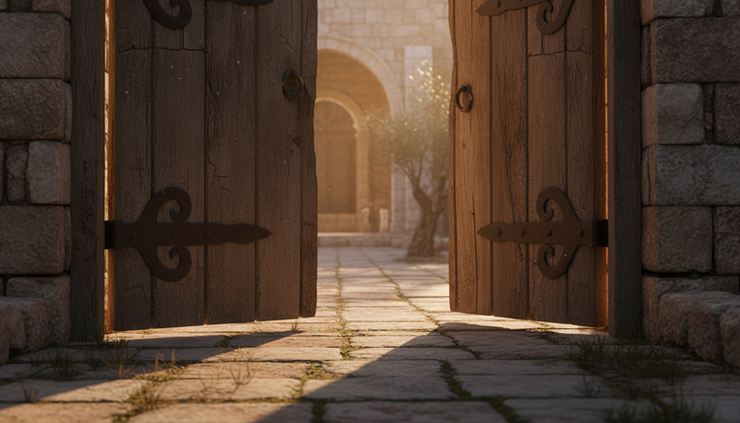
Then comes a beautiful detail: the gates of the city are never shut by day, and there is no night there.
Ancient cities closed their gates at night for protection. Darkness brought danger. Enemies could approach. Thieves could enter. Fear required locks.
In the new Jerusalem, no threat remains. Nothing unclean enters the city. No force of evil waits outside the walls. No night falls over the people of God. The gates stay open because the victory is complete.
This changes the image of Jesus knocking on heaven’s gate. He is not a beggar outside a locked city. He is the conquering Lamb whose sacrifice has opened the way. He is the rightful King, and His people enter because of His finished work.
The gate is open, but not because holiness has been lowered. It is open because sin has been judged, death has been conquered, and the Lamb has made His people clean.
The new Jerusalem shows beauty with purpose
Revelation 21 uses rich images to describe the city: precious stones, pure gold, shining walls, measured foundations, and radiant light. These details can feel strange to modern readers, but they serve a purpose. They show value, purity, order, and glory.
The city is not chaotic. It is measured. It is not dim. It shines. It is not stained. It is pure. It is not fragile. It is secure.
John also says there is no temple in the city, because the Lord God Almighty and the Lamb are its temple. That statement would have startled the first hearers. The temple had been the place of God’s presence. In the new creation, God’s presence fills everything.
There is also no need for sun or moon to shine on the city, because the glory of God gives it light, and the Lamb is its lamp.
This is not a rejection of created light, as if the sun were bad. It is a way of saying that nothing mediates God’s presence anymore. No shadow interrupts His glory. No distance remains between God and His people.
The nations walk by this light. The kings of the earth bring their glory into the city. The Bible’s final vision is not small or private. It shows healed nations and redeemed cultures bringing honor to God. Human creativity, dignity, and variety are not erased. They are purified and gathered into worship.
That means the future God promises is not empty. It is not a vague clouded afterlife. It is a renewed creation full of life, worship, relationship, and holy beauty.
The promise is not escape from reality. It is reality healed by God.
Revelation 22 brings the river and the tree of life back into view
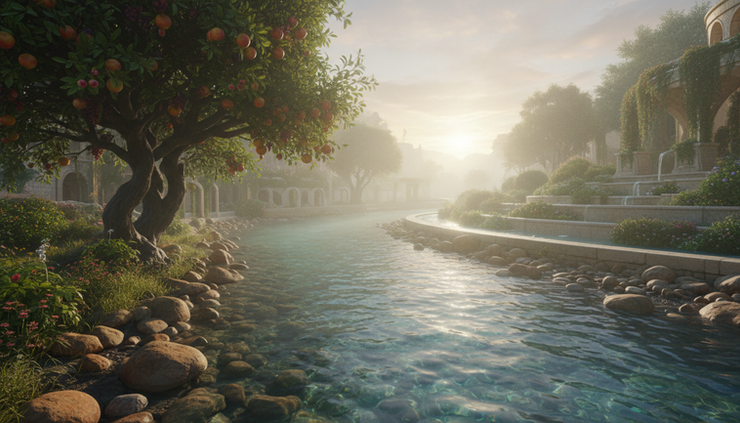
Revelation 22 continues the vision with the river of the water of life. It flows from the throne of God and of the Lamb, bright and clear. Along the river stands the tree of life, bearing fruit and leaves for the healing of the nations.
This image reaches back to Eden. In Genesis, humanity loses access to the tree of life after sin enters the world. In Revelation, the tree appears again. The way back is not found through human innocence, because that was lost. The way back comes through the Lamb.
The Bible’s final chapter does not simply return to the beginning. It moves beyond it. Eden was a garden. Revelation shows a garden-city. Eden had the possibility of rebellion. The new creation stands after evil has been defeated. Eden began with innocence. Revelation ends with redeemed worship.
The river flows from the throne. Life does not come from human effort, religious performance, or moral achievement. Life comes from God and the Lamb.
This matters for the weary heart. Many people imagine the Christian life as a long climb toward a locked gate. Try harder. Do better. Hope you make it. Revelation 22 gives a different image. It shows water flowing freely from the throne and an invitation calling the thirsty to come.
Grace is not an afterthought at the end of the Bible. Grace has the final word.
The greatest promise is seeing His face
Revelation 22 says God’s servants will see His face. This is one of the most tender and powerful promises in Scripture.
In the Bible, seeing God’s face means intimate fellowship, full acceptance, and direct presence. In the old order, sin made that impossible. God’s holiness was too great, and human impurity too deep. In the new creation, the barrier is gone.
His name will be on their foreheads. That image means belonging. The people of God are marked as His own. They are not nameless, lost, or forgotten. They belong to the King.
They will reign forever and ever. This does not mean selfish power or prideful rule. It means restored human purpose. Humanity was created to bear God’s image and steward creation under His rule. Sin twisted that calling. In the new creation, the calling is restored.
Revelation does not end with God’s people floating in passivity. It ends with worship, service, and reign. The life to come is active, holy, and full.
This is why Revelation 21 and 22 speak so strongly to present suffering. They do not erase today’s pain, but they place it inside a larger story. The world may feel like a locked gate at times. Grief can feel final. Evil can look entrenched. Death can seem absolute.
But the final vision of Scripture says otherwise. The One seated on the throne speaks. The Lamb reigns. The Spirit and the bride invite. The gates remain open. The curse is gone.
The invitation at the end is for the thirsty
Near the end of Revelation 22, the invitation becomes personal: let the one who is thirsty come. Let the one who desires take the water of life freely.
That invitation is not vague religion. It is centered on Jesus. The same chapter repeats His promise: He is coming soon. His return is not presented as a threat to those who trust Him, but as the arrival of the bridegroom, the King, and the faithful witness.
The final prayer of Scripture responds, “Come, Lord Jesus.”
That short prayer holds both longing and trust. It longs for the end of suffering. It longs for justice. It longs for resurrection. It longs for the day when faith becomes sight. It trusts that Jesus knows the time, keeps His word, and will finish what He began.
The promise of Jesus Knocking on Heaven’s Gate is really the promise that Jesus stands at the threshold of God’s completed future. He calls the thirsty. He welcomes the redeemed. He brings the holy city down. He wipes away tears. He opens what sin had closed.
This invitation also searches the heart. Revelation 21 and 22 contain comfort, but they also contain warning. Nothing false, corrupt, or evil belongs in the city. The point is not to make tender consciences afraid. The point is to show that God’s future is truly holy.
A world without death must also be a world without sin. A world without tears must also be a world without cruelty. A world filled with God must be cleansed of everything that destroys.
The good news is that Jesus does not call people to cleanse themselves before they come. He calls the thirsty to receive. He is the Lamb, the light, the temple, and the coming King.
Hope for now while we wait for then
Revelation 21 and 22 are not only about the future. They shape how believers live now.
They teach endurance. If God will make all things new, then suffering is not meaningless.
They teach holiness. If nothing unclean enters the city, then sin is not harmless.
They teach worship. If the Lamb is the lamp of the city, then Jesus belongs at the center now.
They teach courage. If the gates never shut in the world to come, fear does not get to rule the present.
They teach compassion. If the leaves of the tree are for the healing of the nations, God’s people should care about healing, mercy, and justice even before the final day.
Christian hope is not denial. It is defiance against despair. It looks at death and says, “You will not last.” It looks at tears and says, “God will wipe you away.” It looks at the closed doors of this age and remembers the open gates of the city to come.

The last word is promise
Revelation 21 and 22 do not end the Bible with speculation. They end it with a voice.
Jesus says He is coming soon. The Spirit and the bride say, “Come.” The thirsty are invited to receive the water of life. The city shines. The river flows. The tree bears fruit. The curse is gone. The servants of God see His face.
That is the promise behind the image of Jesus knocking on heaven’s gate. The future is not sealed against God’s people. The Lamb has opened the way, and the King is coming with a renewed creation in His hands.
So the final posture of faith is not panic. It is prayer.
Come, Lord Jesus. Bring the city. Open the gates. Wipe away the tears. Make all things new.


Comments